
What Is a Mid-Term Rental? A Plain Guide for Investors
Who rents furnished homes for one to six months, what they earn compared with nightly and yearly rentals, and where the rules change at 30 days.
TL;DR
A mid-term rental is a furnished home rented on a lease for about one to six months, with no single legal definition. Tenants are mostly business travelers, healthcare workers, relocating families and insurance placements, and smaller units near hospitals and employers fit best. One vendor's data puts mid-term nightly rates at about half of short-term rates, with far fewer bookings to fill the calendar. Stays of 30 days or more often fall outside city short-term rental rules but inside tenant law, and tax lines differ by state. Before you buy, get written answers from your city, insurer, lender and HOA.
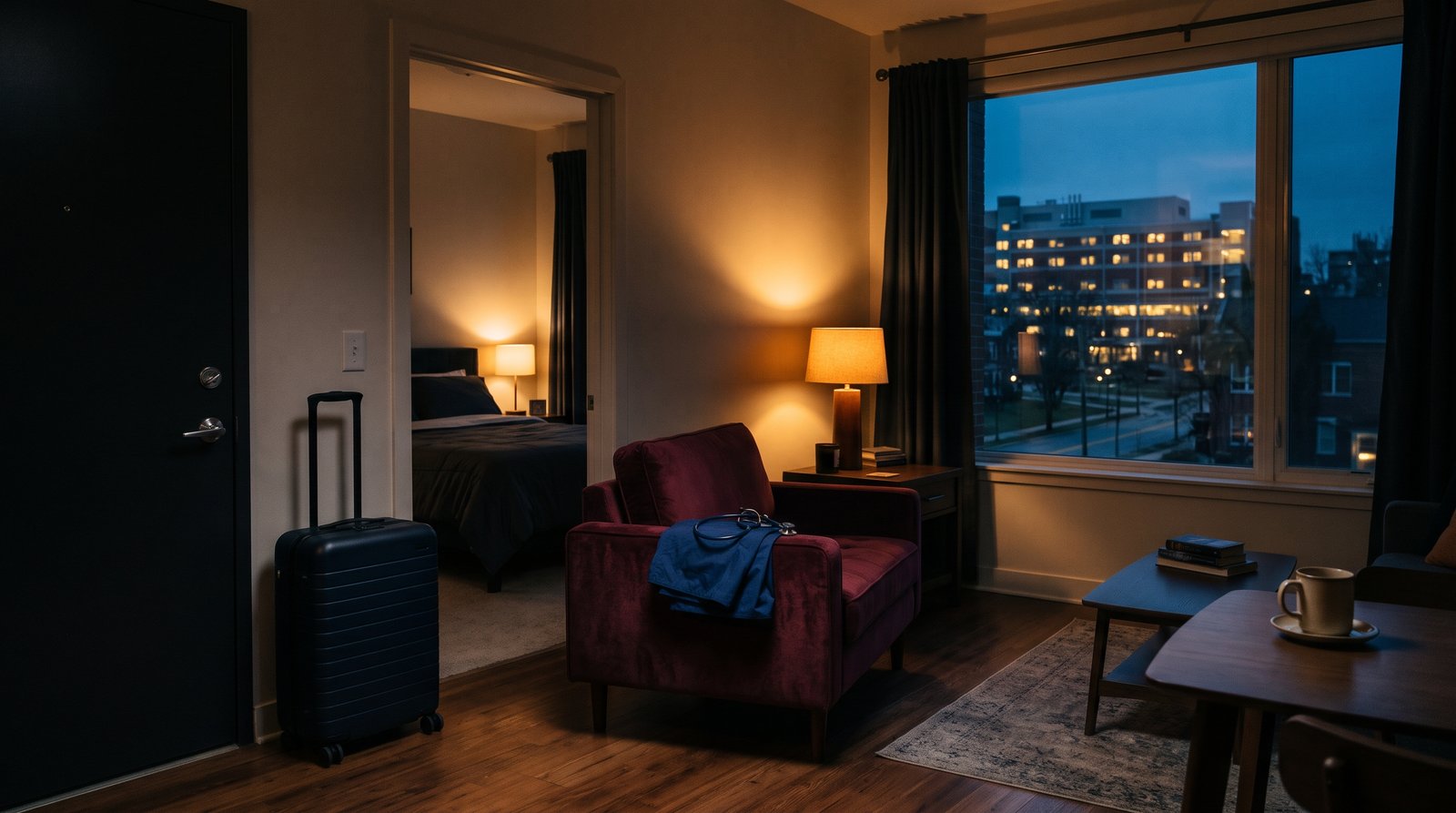
A travel nurse needs a furnished one-bedroom near the hospital for 13 weeks. A family whose kitchen burned needs a house for four months while their insurer pays. Neither wants a hotel or a 12-month lease.
That gap is the answer to "what is a mid-term rental": a furnished home rented on a lease for roughly one to six months, usually to people in transition. It earns less per night than Airbnb and asks more of you than a yearly lease. Below: who rents them, how the money compares, and where the rules change at 30 days.
What Is a Mid-Term Rental?
There is no single legal definition. Each source draws the line a little differently:
- PriceLabs, a pricing-software vendor, defines it as stays of roughly 30 to 180 days (updated August 31, 2026).
- TurboTenant, a landlord-software vendor, says longer than one month but under a year, with most agreements running 3 to 9 months (updated July 24, 2026).
- AirDNA counts "monthly" stays as 28 nights or more (January 14, 2026).
So think "furnished, on a lease, about one to six months, sometimes longer." The threshold that matters for you is not a vendor's. It is your city's short-term rental cut-off, your state's tenant law and your state's lodging tax. Those three often sit at 30 days, but not always.
Mid-Term vs. Short-Term vs. Long-Term Rentals
| Short-term (nightly) | Mid-term | Long-term | |
|---|---|---|---|
| Typical stay | A few nights | About 1–6 months | A year or more |
| Furnished | Yes | Yes | Usually not |
| Utilities, internet, cleaning | Owner (built into the nightly rate) | Owner usually pays | Set by the lease; often the tenant |
| Guest check-ins in a fully booked month | About 8 | 1 or fewer | 1 a year or fewer |
| Rules that usually apply | City STR rules, hotel tax | Often outside STR rules, often inside tenant law | Tenant law |
| Average nightly rate (Hostfully data) | $307 (all stays under 30 nights) | $164 (30 nights and over) | No comparable figure; check local rents |
Sources: nightly rates and the 3.7-night median stay from Hostfully's mid-term rental report (more than 500,000 U.S. bookings over twelve months, analyzed August 2026; page updated November 18, 2026), a property-management software vendor; check-ins per month are our arithmetic from that median; mid-term costs and furnishing from iPropertyManagement (August 24, 2026). The short- and long-term cost cells describe common practice, not survey data.
In Hostfully's data, a mid-term night brings in $164 and a short-term night $307. Put simply: night for night, a mid-term rental earns about half of what Airbnb does.
So do you make half as much? Not necessarily. A short-term rental is rarely booked every night; a mid-term rental can be. Do the math on those two rates and a mid-term rental booked all year (about $59,900 gross) earns as much as a short-term rental booked 53% of the time. That's arithmetic, not a measured result, but it's a useful rule of thumb: if your Airbnb would sit empty about half the year, a full mid-term calendar brings in about the same money. For scale, AirDNA forecasts the average U.S. short-term rental at 57.4% occupancy in 2026 (July 8, 2026).
The catch is the word "full." Mid-term rentals have empty weeks between tenants too. And these are gross averages from one platform's customers, before fees and costs, mixing very different homes and markets; Hostfully itself says the gap doesn't describe any single property. So the real question for your property is: how full would your Airbnb really be, and how many empty weeks would a mid-term rental have?
The other reason owners like the model is less work. In Hostfully's data, the typical short-term guest stays 3.7 nights. Fully booked, that's about eight check-ins a month: eight cleans, eight sets of messages, eight chances for a bad review. A mid-term tenant checks in once and stays for weeks or months. What that gets you is fewer hours and less wear per month, not more money. You may still clean during a long stay; Hostfully assumes a clean about every ten days.
Against a yearly lease, the evidence is thinner. Nomad, a leasing vendor, found that furnished long-term units leased at 108% of its rent estimate vs. 103% for unfurnished (updated November 2, 2026), but took longer to lease: 34 days on market vs. 27. Furnished Finder quotes a premium of 30% to 50% above long-term rents (January 16, 2026), a vendor claim with no occupancy attached. In plain terms: if a yearly lease on your place would bring $2,000 a month, furnished it might bring $2,600 to $3,000.
Is that extra $600 to $1,000 a month worth it? Only if it's still there after the furniture, utilities, internet, cleaning, platform fees and the empty weeks between tenants. So start with the number you'd get without any of that work: the long-term rent.
That's what KWRI's long-term rental report is for. A member agent can pull one for any address. It estimates market rent from nearby long-term rentals and gives a range, not a single number: in a sample report for a three-bedroom house in Toledo, Ohio, the model put rent at $2,110 a month, with a defensible range of $1,610 to $2,600. It also shows what the house costs to own each month, the occupancy you need to break even, and how much to set aside for things that wear out. In the online version you can type in your own costs, including maintenance and furnishing, and see whether the furnished premium survives them. For the wider comparison, see short-term vs. long-term rentals.
Who Rents Mid-Term Rentals
Coverage of the joint AirDNA and Furnished Finder report gives this tenant mix (Short Term Rentalz, January 14, 2026). The article doesn't say which company's data it is. It is vendor data, not a national survey.
| Tenant type | Share |
|---|---|
| Business travelers | 30% |
| Healthcare professionals | 25% |
| Relocating families and insurance placements | 20% |
| Academics | 10% |
| Digital nomads | 5% |
| Other | 10% |
The point: healthcare is a quarter of demand, not all of it.
Travel nurses. Assignments still follow a structure of roughly 13 weeks, and nurses favour furnished homes near hospitals, with a workspace and utilities included (Furnished Finder, March 31, 2026).
Insurance stays. When a home is damaged, the policy's additional living expenses (ALE) can pay for a temporary home. California's Department of Insurance lists temporary housing costs and furniture rental among those expenses (February 5, 2025). Rebuilds after disasters can exceed two years (IRMI, May 30, 2025).
Relocations, business travel and remote workers fill most of the rest. More on that last group in our guide to short-term rentals for digital nomads.
Smaller units fit best. Studios and one-bedrooms make up about 55% of demand (PriceLabs), and 85% of listing page views were for homes with fewer than three bedrooms (coverage of the AirDNA and Furnished Finder report). A four-bedroom suburban house is a harder fit than a one-bedroom near a hospital.
Is Demand Growing?
Yes, by most measures, with a caveat.
A joint AirDNA and Furnished Finder report found that nights booked for 28+ day stays rose from about 20 million in 2019 to 46 million by the end of 2025, up 136%. Short-term nights grew 52% over the same period. Monthly stays were about 19% of total rental demand, growing 8% a year against 3% for short stays (January 14, 2026; vendor data).
Now the caveat. Airbnb's Q4 2025 shareholder letter (February 2026) said short stays "continued to outpace long-term stays (trips of 28 days or more)" on its platform in North America. So on the biggest platform, monthly stays are still growing, just more slowly than nightly ones. What that means for you: mid-term demand is real, but it's a slice of the market, not a wave that lifts every property.
Supply grew faster still. Furnished Finder listings went from about 20,000 before the pandemic to more than 300,000 (January 2026 report), roughly 15 times more. Over a similar stretch, mid-term nights booked grew about 2.3 times, from 20 million to 46 million. The two numbers measure different things, so don't read them as an exact ratio. But the direction is clear: far more homes now compete for each mid-term tenant than before the pandemic.
The takeaway: national growth tells you nothing about your street. Before you buy, look at what you'd be competing with near the address. How many furnished listings are on Furnished Finder and on Airbnb's monthly stays, what do they charge, and do their calendars fill or sit open? If the area is already full of furnished one-bedrooms near the hospital, yours is one more.
What It Costs to Run One
A mid-term landlord pays for things a yearly landlord usually doesn't. iPropertyManagement (updated August 24, 2026) lists utilities, internet, linens, kitchen supplies, cleaning between tenants, lawn care and sometimes pest control. Furniture also wears out sooner.
- Furnishing: vendor estimates run about $7 per square foot (Steadily citing Furnished Finder, updated October 2, 2026) to about $10 (Furnished Finder, January 16, 2026). For a 1,000 sq ft unit, that's $7,000 to $10,000 before any rent comes in.
- Platform fees: Airbnb's host-only fee is 15.5% of the booking subtotal for U.S. hosts, whatever the stay length (Hostfully, September 28, 2026). On a $2,000 a month stay, that's about $310 a month. Furnished Finder charges a $199 annual listing fee (its own figure).
- Turnovers: one check-in per tenant instead of up to eight a month, though you may still clean during the stay.
- Gaps: In coverage of the AirDNA and Furnished Finder report, over 40% of tenants secured housing within two weeks of move-in, so the next tenant often shows up late in the process. Keep cash for empty weeks.
To build a full budget, use our guide to calculating rental expenses.
Where the Rules Change at 30 Days (and Six Months)
Many cities draw the short-term line at 30 days:
- New York City: hosts may not rent an entire apartment or home for fewer than 30 days (Local Law 18).
- Los Angeles: a short-term rental is occupancy for 30 consecutive days or less (Home-Sharing Ordinance fact sheet, undated).
- Dallas: a short-term rental is one rented for fewer than 30 consecutive days. Dallas's ban on short-term rentals in single-family neighborhoods remains blocked by court injunctions, and the Texas Supreme Court hears arguments on December 3, 2026 (D Magazine, Oct 23, 2026).
Taxes have their own lines. In Texas, hotel occupancy tax covers stays of 29 days or less. A guest with the right to stay at least 30 consecutive days is exempt, but any interruption in the term voids the exemption (Texas Comptroller, updated July 8, 2025). Austin exempts a guest from day one if they give written notice on arrival. In Florida, the 6% transient rental tax applies to rentals up to six months (Florida Statutes 2025). A three-month nurse stay there is still taxable lodging.
Myth: "Stays of 30+ days are exempt, so I'm free of the rules." Fact: 30 days often takes you out of short-term rental rules and into tenant law. In California, hotel residents who stay more than 30 days have the same rights as tenants (Department of Real Estate, undated page). In Los Angeles, Just Cause protections apply once a tenant has lived in a unit six months or the original lease expires, whichever comes first (LA Housing Department, September 10, 2026). A three-to-six-month furnished lease there can end with a protected tenant.
The 30-day line isn't universal either. Honolulu passed a ban on 30-to-89-day rentals in non-resort areas in 2022; a federal court blocked that part the same year (2022–2024 rulings). HOAs can set their own minimums: one BiggerPockets forum thread (anecdote, circa 2024) describes HOAs voting in six- and 12-month minimum leases.
This is not legal or tax advice. Check with the city, a local attorney and a CPA. For the bigger picture, see our overview of common STR regulations in the U.S.
The Risks to Price In Before You Buy
The travel-nurse market has shrunk. Travel nurse staffing revenue peaked at $44.6 billion in 2022 (Staffing Industry Analysts, December 18, 2025). After three years of decline, SIA now forecasts 2% growth in 2026 to $14.3 billion (October 7, 2026), and says the market would have declined again without strike revenue. Don't underwrite a deal on one hospital.
The wider rental market is softer. The U.S. rental vacancy rate reached 7.6% in Q3 2026, up from 7.1% in Q1 2025 (Census via FRED, October 28, 2026). That covers all rentals, not mid-term alone. But a soft yearly market can pull your tenants toward cheaper unfurnished leases.
Your property insurance may not cover it. Most policies are written for one of three uses: you live there (homeowners), you rent it nightly (a short-term rental policy) or you lease it for a year (a landlord policy). A furnished 30+ day rental can fall between all three, says Hostfully (June 8, 2026), which sells damage protection for these stays. What that means for you: if a tenant floods the bathroom, your insurer may refuse the claim, and you find out only then. Before your first tenant, ask your insurer in writing: "Is a furnished rental of 30 days to six months covered under this policy?" More in our guide to short-term rental insurance.
Your lender may not count the higher rent. With a DSCR loan, the lender qualifies you on the property's rent, not your income. Lenders and brokers on a BiggerPockets thread (forum, 2026) say many use the lower of your lease rent or the appraiser's market rent. In plain terms: you may plan on $3,000 a month furnished, but the lender may count only $2,000, the unfurnished market rent. That can mean a smaller loan or a bigger down payment. Ask your lender which number they'll use before you make an offer. See also financing an STR property.
Is a Mid-Term Rental Right for Your Property?
It's a reasonable fit if most of these are true:
- The home is close to hospitals, large employers or universities.
- It's a studio to two-bedroom.
- At least three tenant types exist locally: medical, corporate or relocation, and insurance or trades.
- Your numbers still work with a few empty weeks a year, furnishing, utilities and platform fees.
- You have written answers from your city, insurer, lender and HOA.
It's a poor fit if your plan depends on one hospital, your HOA restricts leases under six or 12 months, or the deal only pencils at a premium you can't confirm locally.
What to Do Next
Before you buy or furnish, get four answers in writing:
- The city: where is the short-term rental line, and does a furnished 30+ day rental need a permit or registration?
- Your insurer: is a furnished 30+ day stay covered?
- Your lender: which rent counts for qualifying?
- Your HOA: is there a minimum lease term?
Then test local demand. Find an expert agent who knows the rental market where you're buying, and check local rents and trends in the Rental Forecast report.

Jason Ross
Director · KW Rental Investments
Jason Ross is a seasoned entrepreneur and visionary based in Orlando, Florida, with over three decades of experience across multiple industries. Throughout his extensive career, Jason has consistently demonstrated his ability to navigate diverse business landscapes and capitalize on emerging opportunities. His entrepreneurial journey has encompassed a wide range of sectors, including real estate, technology, media, manufacturing, and more. With a keen eye for innovation and a track record of success, Jason has established himself as a dynamic leader capable of driving growth and achieving exceptional results.
As the Chief Executive Officer (CEO) of TSM Studio, President of Next Move, and Co-Director of Keller Williams Sports and Entertainment, Jason Ross has established an illustrious career in the sports and entertainment industry since 2004. Throughout his tenure, he has had the privilege of serving some of the most renowned talents worldwide. With expertise spanning from branding and marketing to real estate services, Jason possesses an acute understanding of the unique needs and demands of high-profile individuals. His unwavering commitment to excellence and in-depth industry knowledge has solidified his reputation as a trusted professional in catering to the distinctive requirements of this esteemed clientele.
That operating experience is now built into software. Jason is Co-Founder of KW Rental Investments, a platform that gives Keller Williams agents the full rental-investment toolkit in one place — investor-ready listings, rental forecasts and cost estimates, lead capture, and an on-demand education library — proven in production with real agents and real deals rather than in a pitch deck. What it proved there became CommunitySync (mycommunitysync.com), where Jason serves as Director. CommunitySync gives any real estate organization its own branded member portal, public website, agent directory, and content library under its own name and domain — turning a market center, a region, or a niche community into a platform its agents actually run their business on, instead of a stack of tools each agent has to assemble alone.
- Co-Founder of KW Rental Investments, the rental-investment platform for Keller Williams agents — listings, rental forecasts, lead capture, and agent education in a single branded system.
- Co-Founder of CommunitySync (mycommunitysync.com), the community platform KW Rental Investments grew into, giving real estate organizations a branded portal, public website, and agent directory of their own.
- President of Next Move, overseeing 40+ nationwide expansion teams, referral networks, and international training platforms.
- Co-Director of Keller Williams Sports and Entertainment, responsible for the management and development of hundreds of real estate agents across North America while spearheading the creation of the first Sports and Entertainment community within Keller Williams.
- Founder and CEO of TSM Studio, a distinguished professional recording facility with a 20-year legacy, offering top-level marketing services to athletes, entertainers, and large corporate organizations.
- Serving on the Advisory Boards for Full Sail University's Innovation and Entrepreneurship Master of Science Program and Music Business Bachelor of Science Program, providing industry expertise to guide curriculum development and student readiness for post-graduation careers.
Not sure which strategy fits?
Take the investor quiz and get pointed toward the rental strategy that matches your goals — then talk it through with a KW agent who invests for a living.
Frequently asked questions
How long is a mid-term rental?
There is no single legal definition. PriceLabs uses roughly 30 to 180 days, TurboTenant says one month to under a year, and AirDNA counts stays of 28 nights or more. Most people mean a furnished lease of about one to six months.
Does a mid-term rental make more money than Airbnb?
Usually not per night. Hostfully's 2026 data puts mid-term stays at about $164 a night against $307 for stays under 30 nights, so night for night it's about half. But a mid-term rental can be booked every night: on paper, a full mid-term calendar earns about the same as an Airbnb booked 53% of the time. Model your own vacancy and costs.
Who rents mid-term rentals?
In vendor data from a joint AirDNA and Furnished Finder report, business travelers are about 30% of tenants, healthcare professionals 25%, relocating families and insurance placements 20%, academics 10% and digital nomads 5%. Plan for several tenant types, not just travel nurses.
Are 30+ day rentals exempt from short-term rental rules?
Often, but not always. Cities like New York, Los Angeles and Dallas draw the short-term line at 30 days, yet 30 days is also where tenant law often starts, as in California. Honolulu has tried a longer minimum and HOAs can set their own. Check with your city and a local attorney.
What does it cost to furnish a mid-term rental?
Vendor estimates run about $7 to $10 per square foot. For a 1,000 sq ft unit, that is $7,000 to $10,000 before any rent comes in, plus utilities, internet, cleaning and platform fees.