
Which Metrics Indicate a High-Yield Short-Term Rental? Six Numbers, in Order
A listing says $95K a year. Six numbers tell you how much of that holds up, and what to say to the buyer who asked.
TL;DR
A listing can promise big Airbnb money. To see if a rental house will really pay, check six things, one after another: what similar houses nearby earned, how many nights they were booked and at what price, how much is lost when the owners stay there themselves, what it costs to run, how much is left after the loan payment, and how many nights must be booked just to cover the bills. Before any of that, make sure renting to guests is allowed at that address. In our made-up example, a house advertised as earning $95,000 a year ends up $13,000 short once everything is counted.
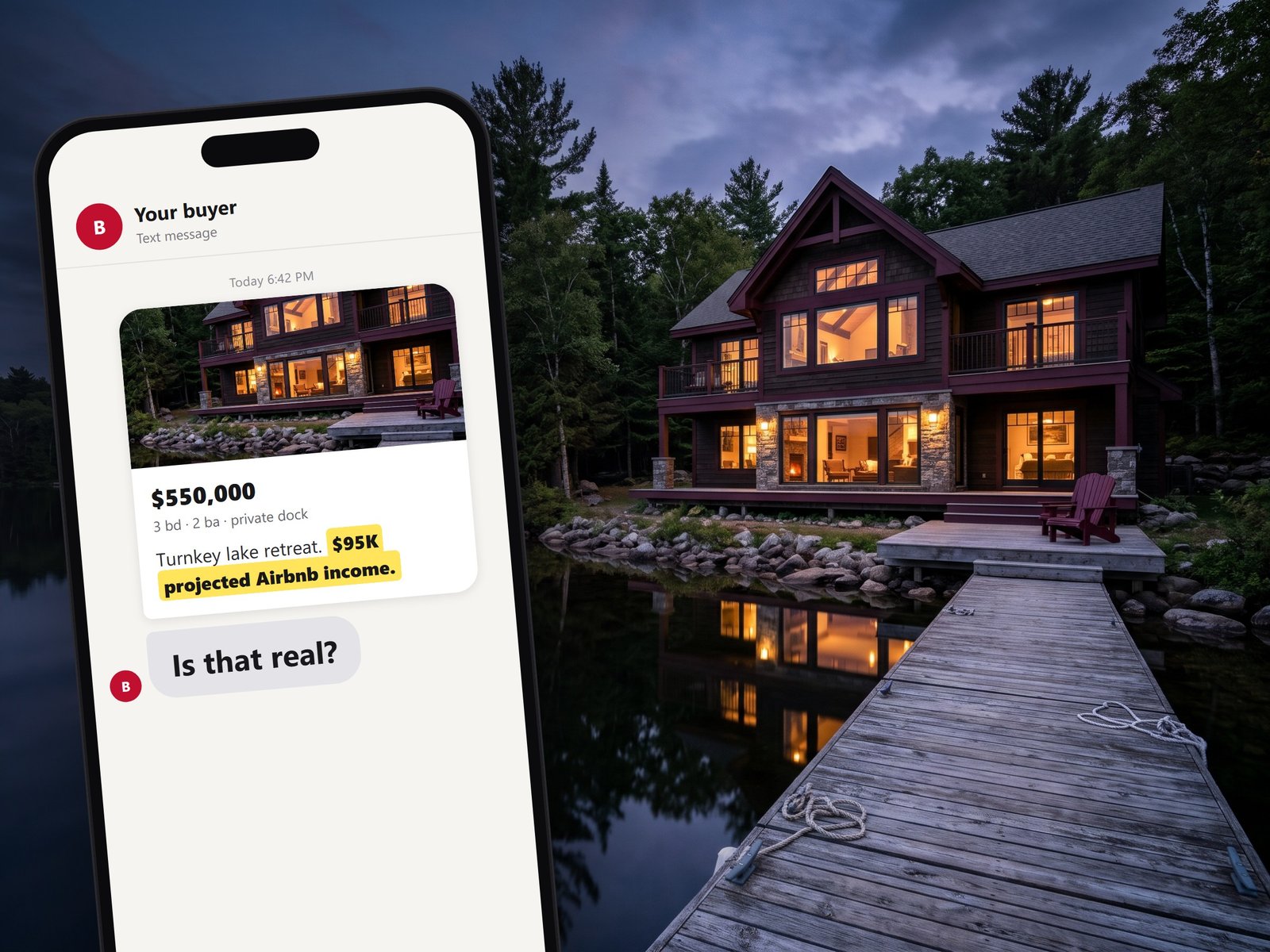
Your buyer forwards a lake house listing. One line is highlighted: "$95K projected Airbnb income." Under it they have typed three words. "Is that real?"
Here is the short answer. Six numbers indicate a high-yield short-term rental (STR): the revenue range of comparable rentals nearby, the nightly rate and occupancy behind that range, revenue after the owners' own weeks, operating costs, the cash left after the loan payment, and the occupancy needed to break even. One check comes before all six: whether the property may be rented short-term at all.
You can walk a buyer through every one of them without predicting a dollar. The sentence to keep ready is this: "I can't tell you what it will earn. I can show you what comparable rentals here have earned, what it costs to run one, and what would have to be true for this one to cover its payment."
The lake house runs through the whole article. Every figure in the example is illustrative, rounded for easy arithmetic and drawn from no real market.
The Six Short-Term Rental Metrics at a Glance
| # | Number | What it tells you | A warning sign |
|---|---|---|---|
| 1 | Comparable revenue range | What similar rentals nearby earned: low, middle, high | One figure with no range and no source |
| 2 | Nightly rate and occupancy | Whether the revenue comes from price, from booked nights, or both | Occupancy above anything the comparables reached |
| 3 | Revenue after owner weeks | What is left once the buyers take their own stays | No nights removed for buyers who plan to use the house |
| 4 | Operating costs and net operating income | How much of the revenue the property keeps | Gross revenue presented as income |
| 5 | Cash left after the loan payment | Whether the owner is paid or pays in each month | A return quoted with no loan in it |
| 6 | Break-even occupancy | How many nights must book to cover everything | Break-even above the middle of the comparable range |
First: Is Short-Term Renting Allowed at This Address?
A revenue number means nothing for a house that cannot legally take guests. Check this before you open any calculator.
Three layers decide it: the city or county ordinance, the zoning, and the homeowners' or condo association documents. They can disagree with each other.
Florida shows how. State law says a local ordinance "may not prohibit vacation rentals," with an exception for local rules adopted on or before June 1, 2011 (s. 509.032(7)(b)). A homeowners' association can still restrict rentals of under six months for every owner (s. 720.306(1)(h)). Allowed by the city and allowed at the address are two separate questions.
"Am I allowed to talk about returns?" Follow your broker's policy and your state's rules. Showing dated, sourced data on what comparable rentals earned is a different act from promising what this one will earn. Send ordinance questions to the city or an attorney, in writing. Our guide to short-term rental rules to check before buying lists what to ask, and how to spot short-term rental potential covers the screen that comes before any numbers.
On the lake house: the city issues permits and the HOA documents allow rentals. The example continues. In another town it would end here.
1. The Comparable Revenue Range
Start with what similar rentals nearby earned over the last 12 months: same bedroom count, same kind of location, same major amenities. Ask for a low, a middle and a high.
The range matters because homes in one town earn very different amounts. AirROI's study of 1,026 U.S. markets found that a top-tenth listing earns about three times the median listing in the same market. A single figure hides which of those homes it describes.
"The tools all disagree." They will, and the reason is mechanical. Each one picks comparables from a different radius and treats owner-blocked nights its own way. AirDNA's Rentalizer, for example, states that its projections assume full availability for 365 days. Our guide on how accurate Airbnb income calculators are covers the differences.
On the lake house: comparable three-bedroom lake rentals earned $48,000 at the low end, $60,000 in the middle and $72,000 at the high end.
The listing's $95,000 sits above the best comparable.
2. Nightly Rate and Occupancy
Revenue is two numbers multiplied together. Average daily rate (ADR) is the average price of a booked night. Occupancy is the share of nights that booked. Multiply them and you get revenue per available night, which the industry calls RevPAR.
Read them together. A full calendar at a low rate and a half-full calendar at a high rate can earn the same.
What counts as good occupancy? AirROI tracked about 677,000 U.S. entire-home listings over the year to August 2026. The median home booked 42% of the nights its host left open. The top quarter started at 58% and the top tenth at 71% (AirROI). A projection built on 75% or more is describing a rare home.
Ask how the tool counts blocked nights too. PriceLabs shows one week with three booked nights and two blocked nights producing occupancy of 60%, 43% or 71%, depending on the definition.
On the lake house: comparables average about $300 a night. The range works out to 160 to 240 booked nights a year, or 44% to 66%. At $300, the listing's $95,000 needs about 317 nights.
That is 87% of the year.
3. Revenue After Owner Weeks
So the range runs from $48,000 to $72,000. Before you take the middle, ask who gets July.
Second-home buyers plan to use the house, and the weeks they want are the weeks guests pay the most for. Every owner night comes out of the top of the rate calendar.
This is where your local knowledge does the work. You know which weeks carry the season in your town. A calculator does not know your buyers want the Fourth of July.
On the lake house: the buyers want three summer weeks. That is 21 nights at a peak rate of about $430, or roughly $9,000. The middle figure moves from $60,000 to $51,000.
4. Operating Costs and Net Operating Income
Revenue is the number everyone quotes. Costs are the number that decides the outcome.
Net operating income (NOI) is revenue minus the cost of running the property, before any loan payment. Divide NOI by the price and you have the cap rate, the return the house would produce if bought with cash.
Three cost lines surprise new owners most:
- Platform fee. Most Airbnb hosts now pay 15.5% of each booking.
- Management. Full-service short-term rental managers charge roughly 15% to 30% of booking revenue, according to Guesty. See self-manage or hire a company.
- Insurance. Steadily puts a short-term rental policy at $2,000 to $3,000 a year, and up to $9,000 in tourist markets such as Florida or California. More in short-term rental insurance: what you need to know.
As a cross-check, Hostaway puts typical short-term rental operating expenses at 40% to 60% of gross rental income. A projection showing 20% has left something out. Our guide to every short-term rental expense line prices each one.
On the lake house (self-managed, illustrative):
| Cost line | Per year |
|---|---|
| Platform fee, 15.5% | $7,900 |
| Cleaning, 35 turnovers | $6,300 |
| Utilities and internet | $4,800 |
| Property tax | $5,000 |
| Insurance | $2,600 |
| Repairs reserve | $2,500 |
| Supplies and software | $1,400 |
| Permit and licence fees | $500 |
| Total | $31,000 |
$51,000 minus $31,000 leaves NOI of $20,000. On a $550,000 price, that is a cap rate of 3.6%.
Hiring a manager at 25% would take about another $12,750.
5. Cash Left After the Loan Payment
Most second-home buyers borrow, so the loan decides what they feel each month. Cash-on-cash return is the cash left after the loan payment, divided by the cash the buyers put in: down payment, closing costs and furnishing.
"The buyer knows spreadsheets better than I do." Good. Give them the inputs and the sources and let them build it. Your part is knowing which inputs are missing. The payment figure comes from their lender. Our guide to financing a short-term rental covers the loan types.
Lenders run their own version of this test, the debt service coverage ratio (DSCR): rental income divided by the full monthly payment with taxes and insurance. Griffin Funding says most programs require 1.0 or higher. Some lenders also discount the projection first. Ridge Street Capital, for one, counts 80% of projected short-term rental income.
What is a good cash-on-cash return? You will find "8% to 12%" repeated on vendor and lender blogs. The ones we read named no dataset behind the range. The useful comparison is the buyer's own: what the same cash would earn elsewhere, set against the value they place on using the house.
On the lake house: the buyers put in about $180,000: 25% down, closing costs and furnishing. The loan is $412,500. At an illustrative 7%, principal and interest come to about $33,000 a year. NOI of $20,000 minus $33,000 is a shortfall of $13,000.
The owners would add about $1,100 a month.
6. Break-Even Occupancy
You now have what the house may bring in and what it costs to run. One question is left, and it is the one your buyer asked first.
Break-even occupancy is the share of nights the house must book to cover its running costs and its loan payment. It turns "Will it pay for itself?" into a number you can hold against the comparables.
Compare it with the range from step 1. Break-even below the low comparable means the house has room for a bad year. Break-even above the middle means it needs to outperform most of its neighbours to stand still.
On the lake house: costs of $31,000 plus the $33,000 payment is $64,000. At $300 a night, that is 213 nights, or 58%. Costs that rise with bookings push the true figure a little higher.
The middle comparable booked 200 nights. With three owner weeks, this house lands near 170.
Reading the Six Numbers Together
Here is the lake house from the listing's claim to the buyer's answer (all figures illustrative):
| Step | Middle of range, three owner weeks | Top of range, no owner weeks |
|---|---|---|
| Listing claim | $95,000 | $95,000 |
| Comparable revenue | $60,000 | $72,000 |
| After owner weeks | $51,000 | $72,000 |
| Operating costs | $31,000 | $37,000 |
| Net operating income | $20,000 | $35,000 |
| Loan payment | $33,000 | $33,000 |
| Cash left per year | $13,000 short | $2,000 |
| Cap rate | 3.6% | 6.4% |
| Cash-on-cash return | Negative | About 1% on $180,000 |
"Would it cover the mortgage?" now has a sourced answer. Used the way these buyers plan to use it, the house covers most of its costs and they add about $1,100 a month. To pay for itself it has to perform like the best comparable on the lake, with the owners giving up their summer weeks.
That may still be a house they want. Plenty of buyers will pay $1,100 a month for a lake house that mostly carries itself. They can now decide with the numbers in front of them.
This article judges the numbers. For the calculation step by step, see how to use an Airbnb income calculator and how to build a full STR revenue and ROI projection.
All six numbers are before tax. Short-term rental tax benefits can change the picture, and that conversation belongs to the buyer's CPA.
Red Flags in a Revenue Projection
- One number with no range, no source and no date.
- Comparables that are bigger, closer to the water, or have a pool or hot tub this house lacks.
- A peak-season nightly rate multiplied across the whole year.
- Occupancy above anything the comparable homes reached.
- No owner weeks removed for buyers who plan to use the house.
- Gross revenue presented as income, with cleaning, management, platform fees and insurance left out.
- No mention of a permit, an HOA rule, or how many new rentals have opened nearby.
What to Say to Your Buyer
"If my number is wrong, they'll blame me." Then make it someone else's number, with a date on it, shown as a range. Here is a reply to that forwarded listing:
“Good question. I can't tell you what it will earn. I can show you what comparable rentals here have earned, what it costs to run one, and what would have to be true for this one to cover its payment. Give me a day and I'll bring the report.”
And at the showing, report in hand:
“This shows a low, a middle and a high, based on rentals like this one. These are past results for other homes. Yours will depend on how you run it and how many weeks you keep. For the tax side, talk to your CPA. For the payment, your lender. For the permit, I'll send you the city's page.”
Pick one listing a buyer of yours is weighing this month. Run the six numbers on that address, in order, and bring the result to your next conversation. The short-term rental report is a member tool. KW agents can join KW Rental Investments, run the report for the property and hand it to the client under their own name.
Not sure which strategy fits?
Take the investor quiz and get pointed toward the rental strategy that matches your goals — then talk it through with a KW agent who invests for a living.
Frequently asked questions
What is a good occupancy rate for an Airbnb?
AirROI tracked about 677,000 U.S. entire-home listings over the year to August 2026. The median home booked 42% of the nights its host left open, the top quarter started at 58% and the top tenth at 71%. A projection that assumes 75% or more describes a rare home. Always ask how the tool treats owner-blocked nights, because the same calendar can produce three different occupancy rates.
What is a good cap rate for an Airbnb?
Cap rate is net operating income divided by price, so it changes with local prices and costs. No single figure fits every market. Blogs often quote 6% to 12% with no dataset named. Compare the cap rate with other properties in the same market, and check that the income behind it has every operating cost taken out.
What is a good cash-on-cash return for a short-term rental?
Cash-on-cash return is the yearly cash left after the loan payment, divided by the cash the buyer put in. The 8% to 12% range repeated online comes with no named source in the articles we read. The buyer sets the bar: what the same cash would earn elsewhere, weighed against the value of using the home themselves.
What DSCR do lenders want for a short-term rental?
Lenders divide rental income by the full payment including taxes and insurance. Griffin Funding says most programs require 1.0 or higher and that most lenders want 1.25 or higher. Some lenders discount projected short-term rental income first; Ridge Street Capital counts 80% of the projection. The buyer's lender gives the figure that applies to them.
Can a real estate agent share a rental revenue estimate with a client?
Follow your broker's policy and your state's rules. Present what comparable rentals earned as a dated, sourced range, and say plainly that it describes other homes. Leave tax questions to the client's CPA, loan terms to their lender, and permit or ordinance questions to the city or an attorney.